On an important fishing ground in the eastern Gulf of Alaska, sperm whales have figured out a new way to find food – they take hooked fish off of longline gear before the fish can be hauled in. The fishermen are worried that this behavior may cause entanglements with the whales and the gear and don't like the loss of fish. They have approached government scientists to help them deal with this emerging problem.
Sperm whales are an endangered species, so fishermen and scientists are concerned. While there have been no sperm whale deaths or serious injuries from entanglements in longline fishing gear in Alaska, it has happened in other places. And as interactions in Alaska continue, the likelihood for it is high. Sperm whales feed mainly on squid, but have been known to dine on different kinds of fish too. In the eastern Gulf of Alaska they appear to be feeding on sablefish as well.
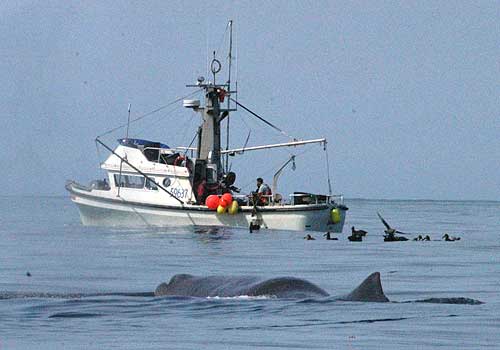
Sablefish is a bottom-dwelling fish that inhabits deep waters. Very high in oil content, its flesh is rich and buttery, making it very desirable to gourmet tastes. Much of the catch is sold to Japan for good prices. In Alaska, the fishermen going after sablefish use longlines – one long line, up to 2 miles long, laid on the ocean bottom with baited hooks set at intervals along its length. Some fishermen have lost up to 25% of their catch to sperm whales picking off the hooked fish from the longline.
Government agencies, scientists and fishermen are working together to find a way to discourage or even eliminate sperm whales/longline interactions. The first step is collecting information: When do these interactions happen? Is it seasonal? Does it happen at a particular time of day? Which whales are hanging around the fishing grounds? Researchers will identify those sperm whales with photography and genetic tissue samples. This information will define the scope of the problem and provide baseline information. The next step using, acoustical studies, will be to study how the whales pick off the hooked fish and what cues the whales use to find the fish. Finally, the research will be used to find solutions to the problem.